
The One Skill That Will Make You 10 Times The Hockey Player
Learn To Skate With And Handle The Puck With Your Head Up
First of all keeping you head up while skating with a puck is not an innate skill. It is a skill that needs to be taught and it can be learned. There is specific understanding required and there are specific physical skill sets to be mastered.
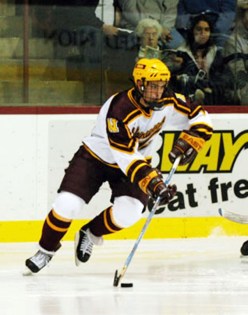
The proper technique is to skate with the head up focusing; as much as possible, everything that is going on on the ice around you while maintaining control of the puck by being aware of it using your peripheral vision as much as possible. The opposite; focusing on the puck while using peripheral vision to be aware of what going on around you on the ice, is simply wrong. It not that you never put your head down; it just that you want to minimize this as much as possible and keep you head up as much as possible.
If You Can’t Control Your Lower Body,
You Won’t Be Able To Control Your Upper Body
There is a lot action going on when playing hockey. Rapid skating, change of direction, stopping and starting, and transition from forward to backward and back again. Since your upper body is attached to your lower body; the more skilled and in control you are with you skating, the better your chances of being proficient at handling a puck while skating.
I’ve always been an advocate of getting proper skating instruction from a qualified source. If you’re going to be an ice hockey player, you’re going to have to put on skates and you better know how to use them proficiently.
Proper Attitude Of The Body
The good news is that the proper attitude of the body is the same as that necessary for efficient skating. An athletic position with feet apart, knees bent and a slight forward tilt of the upper body. The position you would see a football linebacker take or the position one would take if someone were to toss you a duffel bag with some heft to it and you were to catch it in your arms.
Every sport involves “controlled tension”. In this case you want the least amount of tension necessary for the task and the hands, arms and shoulders should be as relaxed as possible. The arms must hang free from the body and the shoulders should be relaxed. (If you ever feel that the arms are locked into the chest or that the shoulders raised and tense; big trouble and won’t work.)
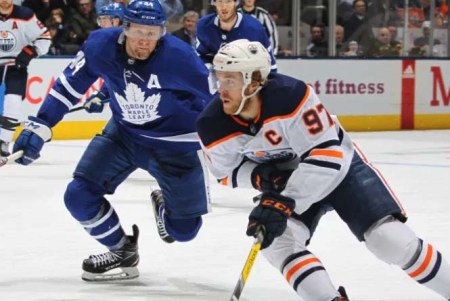
Proper Use Of The Hands, Arms & Upper Body
It’s tough to describe in writing, but I’m going to do my best.
Here’s how they work together:
- The upper hand on the stick rotates and cups the blade of the stick over the puck as it moves from side to side. This action serves for feel and will tend to keep the puck on the blade of the stick during all skating and stick handling maneuvers.
- The lower hand is kept loose and allowed to move freely up and down the shaft of the stick to accommodate the action being taken.
- The arms are kept free from the upper body to allow for the motions that will accommodate the freest and further movement of the puck from the body.
Some Exercises
As a practice exercise, you can stand in an athletic stance with knees bent and feet a comfortable distance apart (using the above and shifting your weight), take the puck and move it as far away from your core in front of you on your backhand side and from there take the puck as far behind you and away from your core on the backhand side. Then as far as possible directly in front of your body and then as far behind your body between your legs. Lastly as far in front and behind on your forehand side.
Another exercise is to stack handle a ball in front of a TV in your rec room. Watch whats on TV and be aware as as much as possible in the room while seeing the ball in your peripheral vision and feeling the ball on your stick. You’ll be surprised how much you can see in the room and still see the ball.
In the next blog I want to give some closing thoughts and knowledge about this subject.
Note:
If you’re new to this blog and reading it from Facebook or Twitter, make sure to click on the BLOG/NEWS link in the menu at the top of the page and scroll down to read previous blogs on this and other subjects. Otherwise you won’t be able to get to previous blogs.

 In the last blog I wanted to alert new parents of some the reality they may face at try-out time in efforts for their child to make a team. There was an important topic that dealt with a troubling aspect of minor hockey today. A lot of teams are already set by try-outs and the available of openings on a team may be limited or even nonexistent. Now no one from the organization will ever alert you to this and in fact, it will be hushed up in part because the reasons that lead to this are against GTHL rules.
 Years ago there were always jokes among parents that such and such a coach had reportedly committed to 50 players for next year. Under GTHL rules a team can have a maximum of 20 players registered, so obviously, the joke was that many coaches had over-committed.
 First let me say that this is based on my experience with the GTHL of the greater Toronto area which happens to be the biggest minor hockey system in the world. I’m not sure exactly how things are done elsewhere, however I’m reasonably certain there are similar experiences in all centres where minor hockey is played.
 At one time in the GTHL the try-outs could begin only after the GTHL held its annual meeting which was traditionally held the first Sunday in May.
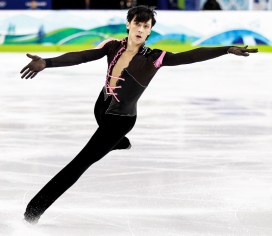 Figure skating has specific elements that differ from the skating requirements in hockey as a result of some very distinct and different objectives.

 Mike Serba Memorial Golf Tournament