Mike Serba Memorial Golf Tournament

Remembering Mike Serba

  • Home
  • About Mike
    • Learn About Mike
    • Photos of Mike
    • Videos of Mike
    • Memories of Mike
    • The Gift of Life
  • Blog / News
  • For Kids Charities
  • Our Event
  • Sponsors
  • Photo Gallery

Humboldt Broncos Tragedy – A Final Commentary

Posted by Jim on May 25, 2018
Posted in: Hockey, hockey Skills, how to succeed in hockey, Humboldt tragedy, Jim Serba, mike serba, mike serba memorial golf tournament, Russian hockey skills, understanding hockey.

The Humboldt Broncos Tragedy 

A Final Commentary

In my last blog I wrote that reality is that for 99.9% of those drawn in by this tragic event; life will go on and things will change very soon by the inevitable reality of their lives just moving forward. However; for those that lost a loved one or whose loved one’s life has been forever greatly changed, things will never be the same.

I’m certain still at this point in time those directly effected with a loss in their family do not fully realize the impact of these events. Almost certainly all are in some stage of an emotional state of shock. All of the public outpouring and memorial ceremonies have served as a distraction from the full and eventual impact of a new reality. These events and their distractions have largely come to an end.
I cannot tell the parents and family of those who lost a loved one how to handle their loss and their grieving. I know what works for me, but all I can say is I hope they are all able to find whatever helps them deal with their loss.

What I can tell them is they will not be the only one’s to remember those that are gone. I for one will certainly not forget them. There is a huge hockey community that will not forget them; especially those that played with them over the years.

I just want to share this recent event. I received the following communication from a Norwich Cadet hockey teammate of my son Mike”

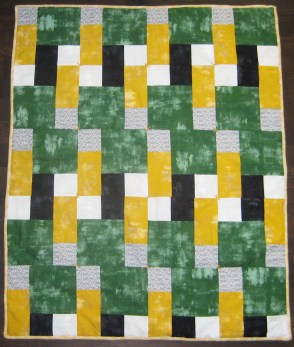
“Hello Mr. Serbs. With the recent tragedy here in Sask my family and myself were thinking about you. My mother made a quilt with the Humboldt colours and we were wondering if we could send it out to you. Hope you’re doing well!!! Love Chance”

A few days later the quilt pictured in this post and made by Patti; Chance’s wonderful mother, arrived at my place. It is a great comfort that my son Mike is still remembered after all these years and the gift and display of this quilt is a source of great comfort. So I can assure you that the those lost will continue to be remembered for a long time.

Those that were lost are no longer able to shape their legacy on this mortal coil. At Norwich University, there is a scholarship awarded every year in my son’s name. The scholarship is a lasting legacy in memory of my son Mike and is a source of pride and comfort. Just a suggestion …. perhaps from some of the monies that have been collected you might want to start a scholarship in the memory of this tragedy and those who were lost ….. just a suggestion.

The Humboldt Broncos Tragedy 

A Final Commentary

I will continue on with my blogs on hockey soon.

Note:

If you’re new to this blog and reading it from Facebook or Twitter, make sure to click on the BLOG/NEWS link in the menu at the top of the page and scroll down to read previous blogs on this and other subjects.


Share this:

  • Click to share on X (Opens in new window) X
  • Click to share on Facebook (Opens in new window) Facebook
  • Click to share on Pinterest (Opens in new window) Pinterest
  • Click to share on LinkedIn (Opens in new window) LinkedIn
Like Loading...

The Truth About Hockey Continued (XV) – Can Hockey Skills Be Taught – Part 3A

Posted by Jim on May 17, 2018
Posted in: Hockey, hockey Skills, how to succeed in hockey, Jim Serba, mike serba, mike serba memorial golf tournament, Russian hockey skills, understanding hockey.

The Answer Should Be Obvious

Of Course Hockey Skills Can Be Taught

The teaching of complicated physical skills involving the arts, sports and other activities has been going on for hundreds or years now. In the earliest of times the teaching techniques were more based on trial and error and modified based on the extent success or failure. In modern times (like a great many things) scientific principles, research and computer technology has improved the learning curve.

Here’s Basically (In My Opinion) How It Works

Think about an activity such as learning to play the violin. (I believe the same principles would apply to just about any athletic or artistic endeavor requiring precise and controlled physical movement such as piano, ballet, golf, javelin throw and endless more.)

The playing of violin has been around for hundreds of years and undoubtedly the teaching has evolved during that time most probably from some trial and error leading to achievement of success.

It’s not hard to imagine a young boy or girl being taught by an accomplished violinist who has become a proficient teacher. They would be taught how to hold the violin and the bow. They would be taught the various details of holding the violin and the movement of the hand on the finger board and movement of the bow across the strings. Various exercises would be given for practice of these movements. Since every physical endeavor is an exercise in controlled tension; surely the teacher would be describing points of  pressure and those areas of the body requiring relaxation. A good teacher would find visually descriptive imagery to relay the relative points of tension and relaxation to the student help advance the learning process.

Finally when enough of the basics have been accomplished; notes are strung together and actual music begins to be made. From there it’s not hard to imagine a continued progression.

Rising To The Top

I’m certain that everyone that rises to the top of any endeavor will more than likely have experienced the following; starting at a young age, having received competent teaching, put in a lot of time in practice, had support and encouragement throughout, and had an absolute passion for the activity and desire to achieve excellence. In the end a few rise to the top.

 Here’s How It Goes – An Analogy 

There are hundreds of violinists playing in orchestras across North America. If you would listen to any one of them play, it would be impressive. Everyone one of them has gone through the essential elements leading to success as outlined above.

From all of the accomplished violinists in the world, how many are considered “virtuoso” performers? The reality is that there are just a handful considered “virtuoso” artists. In the hockey world this would equate to the Gretzkys, Howes and Orrs. (I’ve picked players that have stood the test of time because of my belief that greatness must be measured over time.)

While there are only a few “greats” there are plenty of spots on teams for those that are highly competent. I’m not suggesting it’s at all easy to make it to the professional ranks for the reality is that a very small percentage ever make it there. But remember there are also other great opportunities for athletes such as scholarships and don’t ever underestimate the incredible life learning experience of the journey.

Of Course Hockey Skills Can Be Taught


There’s a lot more to come. In Part 3B I’ll be more specific about the hockey skills learning process and it’s history of development.

Note:

If you’re new to this blog and reading it from Facebook or Twitter, make sure to click on the BLOG/NEWS link in the menu at the top of the page and scroll down to read previous blogs on this and other subjects.



Share this:

  • Click to share on X (Opens in new window) X
  • Click to share on Facebook (Opens in new window) Facebook
  • Click to share on Pinterest (Opens in new window) Pinterest
  • Click to share on LinkedIn (Opens in new window) LinkedIn
Like Loading...

Humboldt Broncos Tragedy – For Those That lost A Loved One

Posted by Jim on May 7, 2018
Posted in: Hockey, hockey Skills, how to succeed in hockey, Humboldt tragedy, Jim Serba, mike serba memorial golf tournament, Uncategorized, understanding hockey.

The Humboldt Broncos Tragedy 

Follow-Up

For Those That Lost A Loved One

Those Lost Will Not Be Forgotten


When I wrote my blog about the tragedy that befell the Humboldt hockey team; there was so much more that I wanted to say, but didn’t feel that the time was right just then.

It’s remarkable how this event has resonated around the world and touched so many people who have been mobilized to show their sympathy and support in so many ways. From the “wear a jersey” day to leaving out a  hockey stick on your porch and as far away as the Ukrainian National hockey team leaving flowers at the Canadian embassy in Kyiv, Ukraine. Also, the tremendous and generous outpouring of donations of money that has now surpassed 10.5 million dollars from more than 120 thousand donors.

The Absolute Reality Is – For Most, Life Will Go On 

And Soon

The empathy and resultant outpouring of support was and still is remarkable. Many around the world were moved to support the Humboldt Broncos in this time of this tragedy and there’s no doubt that this support is genuine and has been a great comfort to those that have lost a loved one.

The reality is that life will go on and things will change very soon. For 99.9% of those drawn in by this event; their lives will soon be moved on by the inevitable reality of their lives just moving forward; however for those that lost a loved one or whose loved one’s life has been forever greatly changed, it will never be the same.

At this point those directly effected with a loss in their family do not fully realize the impact of these the events. Almost certainly all are in some stage of an emotional state of shock  and without  any full possibility of that realization. Additionally they have been preoccupied and distracted by the public outpouring and memorial ceremonies. These events and their distractions will soon come to and end.

For Those That Lost A Loved One

For those that have lost a loved one; and for those who have suffered a permanent life changing injury and for their parents, their life will never be the same. I fear that they will feel a loneliness and eerie emptiness very soon. Their lives have been changed forever  and simply will not be able to go on as before.

I have a couple of thoughts that I feel a need to share.

First, support each other through these next more lonely and difficult times. Second, I hope you can find some solace when I assure you that you and those lost will not be forgotten. I know this from my own experience. Finally, help each other to find a way to create a lasting legacy in their memory …. they deserve it.

Those Lost will not Be Forgotten


There is more that I would like to say, but feel once again that the time just was not right. I will write an additional follow-up soon

Note:

If you’re new to this blog and reading it from Facebook or Twitter, make sure to click on the BLOG/NEWS link in the menu at the top of the page and scroll down to read previous blogs on this and other subjects.


Share this:

  • Click to share on X (Opens in new window) X
  • Click to share on Facebook (Opens in new window) Facebook
  • Click to share on Pinterest (Opens in new window) Pinterest
  • Click to share on LinkedIn (Opens in new window) LinkedIn
Like Loading...

The Truth About Hockey Continued (XIV) – Can Hockey Skills Be Taught – Part 2

Posted by Jim on April 25, 2018
Posted in: Hockey, hockey Skills, how to succeed in hockey, Humboldt tragedy, Jim Serba, mike serba, mike serba memorial golf tournament, Russian hockey skills, understanding hockey.

A Warning To Parents

Hockey … To The Exclusion Of Everything Else?

There has been a disturbing trend in sports in recent years leading  to absolute and complete immersion and dedication to one particular sport.

This trend has been going on for some time and then got new legs and a big boost from a book by Malcolm Gladwell published in 2008  titled The Outliers. In this book Gladwell  repeatedly mentions the “10,000-Hour Rule”, claiming that the key to achieving world-class expertise in any skill, is to a large extent, a matter of practicing for a total of around 10,000 hours.

It seems a great many people took that to mean that all they have to do is spend 10,000 hours at an activity to achieve greatness at that activity.

Gladwell’s  conclusions have pretty much been completely debunked and even rejected by the prominent psychologist Anders Ericsson upon whose work Gladwell based the book

This myth though, still continues. To quote an article by Rachel Nuwer:

“So despite the new evidence that the 10,000 rule is bull, like the studies and articles that came before it, that message will likely fall on many deaf ears. The 10,000 hour rule seems to have entered into the common lore about success: it’s a nice idea, that hard work will actually pay off. And no peer-reviewed study has so far succeeded in toppling that catchy message.” 

When it comes to hockey, we have Hockey symposiums where supposedly the best and brightest of the sport get together to discuss the state of the game, new advances and how to move the game forward.  Gladwell’s 10,000 hour theory was presented at one of these symposiums with the examples of Sidney Crosby and Alexander Ovechin. Crosby and Oveckin were offered up as some kind of proof of this theory.

Ironically; in response to severe criticism and debunking of his book, Gladwell is quoted as stating: “There is a lot of confusion about the 10,000 rule that I talk about in Outliers. It doesn’t apply to sports. And practice isn’t a SUFFICIENT condition for success”. However my recollection is that Gladwell used of Wayne Gretzky as  an example for proof of his theory.

Some Of My Experience

One year when I coached a double A minor peewee team that went on to win the MTHL championships and went on to the All Ontario Championships, we ended up playing well over 100 games by the time everything was over. The season started in August and finished some time in April. We started with our preseason camps in August, followed by preseason exhibition games which was then followed by a 42 game regular season.  The play-offs went 4 rounds to win the west division championships followed by a 5th round for the City championships which was then followed by the All-Ontario championships. Interspersed between all of this there were at least 5 weekend tournaments. During all of the time from the beginning of the season to the end, the norm was 2 practices a week. That’s one hell of a lot hockey and time in an arena.

Summers in Canada are short. Why would you want to spend all of your time in a hockey arena during the summer? My recommendation is to get away from hockey after the season and do something else. There are all kinds of activities and some great outdoor sporting activities that have cross-over benefits. Soccer is great for conditioning, coordination & balance as well as positional play. Field lacrosse is fantastic because it has all of those elements plus hand-eye coordination and body contact.

I spent a lot of time on the ice with Steven Stamkos and got to know him quite well. He and his family always had a great balanced approach to sports and life. Steven would always play baseball with his buddies in his home town of Markham, Ontario during the summer months. Even after being drafted and playing with the Tampa Bay Lighting, Steven  would still play baseball with his buddies during the summer and as far as I know that may continue to this day.

We All Want Our Children To Succeed

But Don’t Develop A Misfit

I feel that complete and total immersion in any one singular activity almost to the exclusion of everything else will tend to produce a misfit.

Get the  hell away from hockey during the summer. Do something else with your kids during that time. Don’t get sucked in by the coaches and the parents talking about the 3 on 3 or 4 on 4 summer hockey league, or the “special elite” summer hockey tournament team. This is especially true in the early years and there will be plenty of time in later years if your child shows the proficiency and the interest. In the early years do your best to make sure your child has a well-rounded experience.

There is lot more that I would like to write to say on this topic; however for right now this is my considered advise. I’m sure I’ll cover this more in the future.

Don’t Do Things To Develop A Misfit

There’s a lot more to come. In Part 3 I’ll write about the learning process; some history and the reality of how it functions.

Also, I’ll have a future followup on my blog about the Humboldt Bronco’s hockey tragedy. Initially, there was a lot more that I wanted to say, but felt the time just was not right.

Note:

If you’re new to this blog and reading it from Facebook or Twitter, make sure to click on the BLOG/NEWS link in the menu at the top of the page and scroll down to read previous blogs on this and other subjects.


Share this:

  • Click to share on X (Opens in new window) X
  • Click to share on Facebook (Opens in new window) Facebook
  • Click to share on Pinterest (Opens in new window) Pinterest
  • Click to share on LinkedIn (Opens in new window) LinkedIn
Like Loading...

Humboldt Broncos Tragedy

Posted by Jim on April 10, 2018
Posted in: Hockey, hockey Skills, how to succeed in hockey, Humboldt tragedy, Jim Serba, mike serba, mike serba memorial golf tournament, Russian hockey skills, understanding hockey.

The Humboldt Broncos Tragedy – This Tragedy Will Never Make Any Sense

My heart goes out to all of those affected by the tragic accident involving the loss of life and injuries of the Humboldt Broncos hockey team. Hockey is in the DNA of Canadians and in towns like Humboldt the local team is especially important and receives extraordinary support.

In particular, to the immediate family …. parents, siblings, and other direct family members of those lost and injured. Especially to those who have lost a loved one.

Also, to the billets of these young players. These are wonderful people who take these young hockey players into their homes and look after them  as if they are their own children. Most do not realize how special these people are.

To the unpaid volunteers (trainers, equipment managers, ticket takers and many more) who faithfully support the team.

To the fans and supporters who may be sponsor, a season ticket holder or a fan who supports and cheers on the team.

To those who are deeply touched and trying to comprehend this tragedy.

This tragedy will never make any sense. Don’t even try. Do your best to support each other and do your best to make sure that those lost are remembered. Those that are gone can no longer shape their legacy … it’s up to those that remain to make sure they are not forgotten.

This Will Never Make Any Sense – Don’t Even Try 

Share this:

  • Click to share on X (Opens in new window) X
  • Click to share on Facebook (Opens in new window) Facebook
  • Click to share on Pinterest (Opens in new window) Pinterest
  • Click to share on LinkedIn (Opens in new window) LinkedIn
Like Loading...

The Truth About Hockey Continued (XIII) – Can Hockey Skills Be Taught – Part 1 – And Why Do It?

Posted by Jim on April 4, 2018
Posted in: Hockey, hockey Skills, how to succeed in hockey, Jim Serba, mike serba, mike serba memorial golf tournament, Russian hockey skills, understanding hockey.


Can Hockey Skills Be Taught?

First – Why Do It?

If you have read the beginnings of my blogs you’ll know that when I started this, I said that I felt being involved in the playing of organized hockey can provide a great many life experiences and learning lessons. If you’re a normal parent that wants the best for your children you will want to do every thing you can to properly prepare them for the inevitable challenges they will face as they go through life. Now hockey isn’t the only pursuit that will provide  a valuable education; I just happen to think it’s a very good one.

Now to get the most out of any learning experience, it seems to me that there has to be a good level of dedication and applied effort in order to get a good result.

If you decide to continue beyond the basic entry level of hockey with your child then you will find that this involvement will require a considerable amount of time, money, and both physical & emotional energy. Since this will be pretty much a given, you might as well proceed with a good level of dedication toward the achievement of excellence.

Jack Of All Trades And A Master Of None

There are never any guaranteed outcomes in life; however I’m certain that if you just dabble in everything you do,  there are valuable lessons that will never be learned.

There’s a well know phrase; “Jack of all trades and a master of none”.

Another way of saying this is: “At everything you do, you pretty much display considerable incompetence”.

There is value in the process of striving to achieve your best and striving for excellence. Everyone that has achieved excellence in any endeavor has probably shared a similar type of process and experience. It takes, effort, time, passion and dedication. It will involve physical pain and mental anguish. There will be frustration when there is a lack of success and failure and yet there will be elation with progress and accomplishment. Most mere mortals will never achieve greatness, however the process involved in this striving is one of the most important lessons in life.

Now it doesn’t have to be hockey to learn this lesson. There are a great many pursuits that will provide this same experience.

With all of the time, money and energy required; If you commit with your family to proceeding to a higher level of hockey, then you might as well put in the dedication and effort towards learning the achievement of excellence. Reality is that most players will not achieve a career in hockey, but that isn’t the issue. The issue is the taking of this learning experience with you for the rest of your life.

Can Hockey Skills Be Taught?

Well of course they can be taught; just like any other skill or pursuit which involves physical dexterity.

Jack Of All Trades And A Master Of None?

There’s a lot more to come. In Part 2 I’ll give you one big piece of advice and an important warning.

Note:

If you’re new to this blog and reading it from Facebook, make sure to click on the BLOG/NEWS link in the menu at the top of the page and scroll down to read previous blogs on this and other subjects.


Share this:

  • Click to share on X (Opens in new window) X
  • Click to share on Facebook (Opens in new window) Facebook
  • Click to share on Pinterest (Opens in new window) Pinterest
  • Click to share on LinkedIn (Opens in new window) LinkedIn
Like Loading...

The Truth About Hockey Continued (XII) – Systemic Problems – Part 2

Posted by Jim on March 14, 2018
Posted in: Hockey, hockey Skills, how to succeed in hockey, Jim Serba, mike serba, mike serba memorial golf tournament, Russian hockey skills, understanding hockey.


Systemic Problems With Minor Hockey Part 2


If The Best Keep Leaving The System, Then What Are You Left With?

Referees

I have to say first; I want to be clear that I’m not talking about refereeing at the most primary level of hockey. Those kids that are 4 & 5 years old at the house league level. The young people refereeing these games are almost always young teenage hockey players from the organization that get some very basic training and get paid a few measly dollars to earn some extra spending money. The 4 & 5-year-old players are just struggling to keep the shiny sharp part of their skates in contact with the ice and the refereeing consists of just shuffling up and down the ice punctuated with the odd face-off. These young referees are at the same stage in the proficiency as the young house league players and yet I’ve seen angry parents tee-off in anger at these poor kids. Please; for heaven’s sake, lighten up and leave these young kids alone.

Now To The Real Paid Referees

When I started coaching years ago no-one was being paid (other than the “de facto” league owners). The only exception were the referees.

What bothered me at that time was that these guys were the only true professionals and many of them were making a lot of extra money. These guys could work 4 or 5 games a night and the pay for referees & linesmen was not at all bad and most of it was cash money that was probably not declared for tax purposes. What further bothered me was that I thought the state of proficiency in refereeing was damn poor. It was extremely frustrating to be a part of a game in which a number of bad calls had an impact on the outcome of the game.

There was a group of supervising officials from the GTHL that would attend games and supposedly review the performance of the on-ice officials, but I found out this was a considerable joke. It was pretty much a “good old boys” club and real criticism and corrective action was probably rare. I’ve seen the supervising officials visit the referees room between periods of a game. Most of the time they just joked; however, I’ve actually witnessed a supervising official give direction on how to call a game in between periods of a play-off game. It’s my opinion that this is absolutely wrong and unconscionable.

Abuse Of Officials

Back in the day and even now, the on-ice officials are subject to a lot of abuse from the fans and coaches. I was pretty good at it in my days. I had a voice that carried and knew just what to say that I could get away with, and wasn’t at all afraid to voice my opinion so that everyone could hear.

There Were Actually A Few Good Ones

While I had a dim view of the competency of many of the on-ice officials, there were a few good ones. As I reflect now it seems to me that becoming a top official is probably as difficult as becoming a top coach or a star hockey player. I don’t know exactly how the 2 or 3 good refs got as good as they were; I just know that these 2 or 3 stuck out from the rest. Firstly they had a very high level of competency in the call of the game but more than that they had way of calming down tense situations. They would handle a player or coach that was upset with a call by listening and explaining. Too many of the other refs would just get pissed and hand out more penalties as a show of power and just make situations worse. As a result the 2 or 3 good refs garnered a lot of respect.

And Then One Day

One day I picked up the major newspaper for my City of Toronto. Right away I saw an article about a recent incident involving a GTHl referee that had occurred a couple of days previously. The referee had assessed a major penalty in the last 10 minutes of a regular season game. A major penalty in the last 10 minutes of a game carried an automatic ejection from that game and a suspension for the following game.

At the end of the game the ejected player and his father parent threatened the referee that they would find out where he lived and get even.

The referee in the game was one of those recognized as being one of the best in the league. I don’t remember his first name but his last name was Marra. After this threat Marra made the decision to quit refereeing.

If The Best Keep Leaving The System, Then What Are You Left With?


There’s a lot more to come. Next I’ll deal with: can hockey skills be taught?

Note:

If you’re new to this blog and reading it from Facebook, make sure to click on the BLOG/NEWS link in the menu at the top of the page and scroll down to read previous blogs on this and other subjects.


Share this:

  • Click to share on X (Opens in new window) X
  • Click to share on Facebook (Opens in new window) Facebook
  • Click to share on Pinterest (Opens in new window) Pinterest
  • Click to share on LinkedIn (Opens in new window) LinkedIn
Like Loading...

The Truth About Hockey Continued (XI) – Systemic Problems – Part 1

Posted by Jim on February 21, 2018
Posted in: Hockey, hockey Skills, how to succeed in hockey, Jim Serba, mike serba, mike serba memorial golf tournament, understanding hockey.

Systemic Problems With Minor Hockey Part 1

If The Best Keep Leaving The System, Then What Are You Left With?

There are 2 more important systemic problems within our minor hockey system that will likely continue for ever. This minor hockey system we have is self-perpetuating and the way it plays out there has never been any incentive for correction and change.

This one deals with the quality of coaches that are available to the system.

It’s my opinion the coach is one of the most important factors in the development of a young hockey player. Too many people get hung up on the organization or the jersey, but the coach you get is the key.

Where Do The Coaches Come From?

If you’ve followed my hockey posts you should be aware or the criticisms of the state of coaching available to the early age levels of our minor hockey system. At this point I’m talking about the levels above the absolute most entry levels of hockey; from House League Select all the way up to Triple A.

The coaching entering the system usually comes from a parent that watches his son’s or daughter’s game and says to himself; “I can do a better job that idiot behind the bench”. From there they fall into 2 general categories; Those that take the job seriously, want to do a good job, quickly find out it’s more difficult than they thought, and then educate themselves so they can do a good job ….. and then there’s the  egomaniac (you can generally spot this one because that’s usually the guy that commands the audience of parents in the lobby and regales them with  examples of his brilliance and knowledge).

Now my preference was to stay away from the “egomaniac” type, but many of these guys actually survive and do quite well. They survive because there are enough parents around that are impressed with and buy into their B. S. As a result, these guys can do well at recruiting and therefore achieve success at winning. My experience has been that while the team will get wins; they never win it all. In the end you won’t get much development for your son or daughter and  the coaching style is such that the experience will be a season with a lot of angst.

I’ve Been Lucky To Know Some Really Good Coaches 

I’ve been lucky to have known and to have worked with some really good coaches that taught me a lot about what it takes to be a good coach. These were the guys that fell into that second category; those who took the job seriously and wanted to do a good job. Over time I’ve become certain that this was a quality that was somehow just a part of their DNA, and built into their personality and character.

Back in the days when I coached the sacrifices were pretty big. There was no compensation and they needed the type of job that provided freedom to make all practices, games and those out-of-town tournaments that begin on a Fridays.

The good coaches I worked with took the job seriously. Their self esteem became wrapped up in the process and ultimately it wasn’t just about winning. Winning, of course, was important but they had figured out that you had to develop your players in order to achieve the most success. And so everything becomes about improving your team by developing all of your players. One coach used this phrase which has always stuck in my mind; “who gets smarter faster”.

In the end, isn’t that what coaching is supposed to be all about?

In The End The Best Coaches Just Leave The System

There are a number of inherent problems that just come with the territory of coaching at the minor hockey level; particularly for those that actually give a damn.

It’s very demanding and comes with hazards that are not at all at first apparent. There’s the time, the cost (not just financial, but also personal) and much more. There are the problems that come with coaching when your son or daughter is on the team. (There are at least 3 or 4 blogs on this subject alone surely to be covered some time in the future.)

The big one is dealing with the parents. (There are at least 10 to 20 blogs on this alone to be covered some time in the future.) Towards the last few years of my coaching this became worse and from everything I’ve heard and observed since then; this is worsening.

In the end what happens is that these good coaches succumb to the same fate as 99.9% of the young hockey players; in part because their fate is tied to the success of (or in most cases lack of) the hockey playing offspring they were coaching. Since 99.9% of young hockey players never make it to the higher levels of scholarships or major junior and beyond, the vast majority of coaches pack it in as well and you don’t have to be a rocket scientist to figure out why.

If The Best Keep Leaving The System, Then What Are You Left With?

Think About it!

There’s a lot more to come.

Note:

If you’re new to this blog and reading it from Facebook, make sure to click on the BLOG/NEWS link in the menu at the top of the page and scroll down to read previous blogs on this and other subjects.


Share this:

  • Click to share on X (Opens in new window) X
  • Click to share on Facebook (Opens in new window) Facebook
  • Click to share on Pinterest (Opens in new window) Pinterest
  • Click to share on LinkedIn (Opens in new window) LinkedIn
Like Loading...

The Truth About Hockey Continued (X) – Coaching In Minor Hockey – Part 3

Posted by Jim on February 8, 2018
Posted in: Hockey, hockey Skills, how to succeed in hockey, Jim Serba, mike serba, mike serba memorial golf tournament, Russian hockey skills, understanding hockey.

Are All Coaches Liars?

This May Seem A Bit Harsh – But ……

You probably won’t be aware of it at first, but you’ll find out soon enough if you child shows noticeably above average skills and production.

Now I know that all coaches are not liars; however I know for certain from experience that more than just a few are out-and-out liars and a considerable number severely embellish one particular part of the truth.

There Are The Usual Promises

There are the usual promises that one hears from a coach as you move up to the higher levels of hockey and if your child is recognized as a really solid producer . It usually goes something like this; “I really think your son/daughter is a great hockey player and he/she would great wearing our jersey and I’d love to have him/her on my team” …. and then it goes on from there to; “they’ll be a first line player for sure”, lot’s of ice time including power play and penalty kill”, absolutely a go-to player” and “captain or alternate captain for sure”.

Why Do They Do It?

 Because The Primary Goal Is To Recruit Well

The first priority becomes recruiting.

And so, they do it because they want to impress everyone. Now that’s not an unusual human trait. Everyone wants to impress but many hockey coaches feel the need to impress and be highly regarded as an important aid to recruiting the best players.

Unfortunately actual “coaching” then becomes secondary. As I’ve written before, coaches feel the need that they absolutely have to win. And so, they quickly come to the conclusion if they can recruit all of the best talent; then they are assured of winning. (Actually, I have good evidence to the contrary. In a future blog I’ll write about a peewee triple A “dream team” that was put together in the early nineties that turned out to be a disaster).

The big area that coaches seem embellish the most is their hockey accomplishments. I’ve found this is where the majority of the majority out-and-out lies are made. I’ve caught coaches “BS-ing” such things as being drafted by an NHL team and playing some games with an NHL team. The reality is that there are some really good sources for verifying this information.

So Why Do They Do It?  –  Because It Works!

Why do they do it?  …. because this is what impresses parents the most. Even with parents that I’ve given advise to about this consistently come back to me with the same comments when talking about a coach or for that matter a guy that’s running a hockey school. They invariably make comments like “this guy was drafted by such-and-such NHL team”, “this guy played in Europe” and so on. This is simply what impresses parents the most. It is a big help in recruitment and good recruiting makes a coach’s life so much more easy.

The idea that this alone is the conclusive determination of a person’s ability to be a great coach is simply not true. Here are some great NHL coaches with little or no high level careers as hockey players; Ken Hitchcock, Jon Cooper, Bob Hartely, Pat Burns, and Scotty Bowman. There are a lot more skill sets that are necessary in order to be a good coach.

Unfortunately, there is now a lack of attention to coaching as the emphasis is so much on recruiting.

Are All Coaches Liars?

There’s a lot more to come.

Note:

If you’re new to this blog and reading it from Facebook, make sure to click on the BLOG/NEWS link in the menu at the top of the page and scroll down to read previous blogs on this and other subjects.


Share this:

  • Click to share on X (Opens in new window) X
  • Click to share on Facebook (Opens in new window) Facebook
  • Click to share on Pinterest (Opens in new window) Pinterest
  • Click to share on LinkedIn (Opens in new window) LinkedIn
Like Loading...

The Truth About Hockey Continued (IX) – Coaching In Minor Hockey – Part 2

Posted by Jim on January 30, 2018
Posted in: Hockey, hockey Skills, how to succeed in hockey, Jim Serba, mike serba, mike serba memorial golf tournament, Russian hockey skills, understanding hockey.

A Guide For Parents

A Guide For Coaches

Too many think if you can skate a bit, draw some drills on a board and blow a whistle, you’re qualified to be a coach. This is so far from reality that it’s actually quite frightening.

This is a huge subject but I’m going to begin with some important essentials for coaches in minor hockey; however at this time, this is directed at parents to act as a guide to help parents to assess a coach. Much of this is also helpful in assessing the teaching quality of a hockey school.

If I were writing strictly as a guide for coaches, I would cover the important elements in a particular order. Since this is meant more as a guide for parents; the order is chosen with that in mind. Parents should look for coaches that demonstrate the following capabilities.

Patience

We’ve all pretty much forgotten what it’s like to be a child. Most daily communications are with other adults in the course work however young children don’t have the level of experience, communication skills and attention span of an adult.

I’m reminded of an interview with NHL coach Terry Crisp who won a Stanley Cup with Calgary Flames. In the interview Crisp talked about a great coach who mentored him in his early coaching career. I can’t recall who it was, but I believe it was Fred Shero (a 2 time Stanley Cup winner) when Crisp was an assistant with Philadelphia. Crisp said that one of the most important things he was told was: “be prepared to explain something to them a thousand times. And when they screw it up the thousandth time; be prepared to explain it to them the thousand and first time.” And these Stanley Cup winning coaches are talking about adult NHL hockey players, not bubble-brained little kids.

Young children have the attention span of a gnat and it’s very easy for a coach to become impatient and frustrated when they just don’t get it even though it’s been repeated several times. At the very young ages it not only requires great patience; it also requires: (a) some knowledge of how to have a command of discipline & orderliness and (b) some knowledge of how to teach. (or how people learn)

Discipline & Orderliness

Without some knowledge on how to maintain discipline & orderliness, you will end up with chaos during a  team practice. A lot of coaches just get frustrated with the kids running around and out of control and resort to yelling at them. First, I don’t think today’s parents will tolerate this and secondly; it just doesn’t work. It may work for the first few times however after a while the kids will just tune it out. There are proven techniques that work to maintain order, but I’ll deal with them later in a blog directed at coaches.

Here are some signs the coach has a few things figured out: they will draw out a drill on the hockey board and have all of the players on one knee while the drill is being shown, they will always have a pylon at the staring point of a drill and they will not allow random shooting of pucks against the boards during drills.

How To Teach or Understanding How People Learn

When I started coaching it was mandatory to become certified by taking some coaching courses. Quite honestly, at the time, I didn’t think they were going to provide me with much that I didn’t already know. I ultimately found (not so much at these coaching courses) how little I knew about the full breadth and depth of knowledge needed to be a really good coach.

There was one very important thing that I did learn in one of my early coaching courses. The course instructors did a great demonstration on the learning process. They sent 3  aspiring coaches out of the room and then explained a little teaching/leaning exercise to the rest of the room. This exercise involved a fairly long series of fairly unusual body movement exercises the aspiring coaches would be asked to perform when they re-entered. When the first came in, the instructor simply explained the movements and then asked the person to perform those movements. This first performance broke down very quickly. With the second guinea pig, the movements were explained and then he  allowed he allowed read the written description. The third guinea pig had the instructions explained, then he read them and finally one of the instructors demonstrated the the movements while explaining them. With each successive guinea pig the level of performance improved.

Watch to see if your coaching staff show, explain, and demonstrate.

Understanding How People Learn

Different people respond to instruction and learn in different ways. At the risk of offending; in my experience, I found that the young girls in the hockey school had a different nature of motivation and responded to a different sort of instruction. The girls wanted more detail whereas the boys responded more visually and instinctively. I found it interesting that the young girls looked as if they were progressing at a slower pace, however they were actually integrating the details of technique much better. From this experience it dawned on me that people respond and learn in different manners. If you’re not getting your point across; change your approach.

People think in pictures. When we describe something to someone pictures are flashing through their minds at a lightning pace bringing meaning to whatever is being described. If you’re not getting results; change the pictures.

There’s a lot more to come.

Note:

If you’re new to this blog and reading it from Facebook, make sure to click on the BLOG/NEWS link in the menu at the top of the page and scroll down to read previous blogs on this and other subjects.


Share this:

  • Click to share on X (Opens in new window) X
  • Click to share on Facebook (Opens in new window) Facebook
  • Click to share on Pinterest (Opens in new window) Pinterest
  • Click to share on LinkedIn (Opens in new window) LinkedIn
Like Loading...

Posts navigation

← Older Entries
Newer Entries →
  • Contacts

    To contact me, just phone or click on my name below to send an email.

    Jim Serba - 416-895-4468
  • Join Our Facebook Group


    I Miss Mike - Remembering Mike Serba
  • Follow Us on Twitter

    My Tweets
  • Like Us on Facebook

    Like Us on Facebook
  • COPYRIGHT NOTICE: This website and its content may not be copied, published, distributed, downloaded or otherwise stored in a retrieval system, transmitted or converted, in any form or by any means, electronic or otherwise, without the prior written permission of imissmike.com or Jim Serba

Blog at WordPress.com.
Mike Serba Memorial Golf Tournament
Blog at WordPress.com.
  • Subscribe Subscribed
    • Mike Serba Memorial Golf Tournament
    • Already have a WordPress.com account? Log in now.
    • Mike Serba Memorial Golf Tournament
    • Subscribe Subscribed
    • Sign up
    • Log in
    • Report this content
    • View site in Reader
    • Manage subscriptions
    • Collapse this bar
 

Loading Comments...
 

    %d